





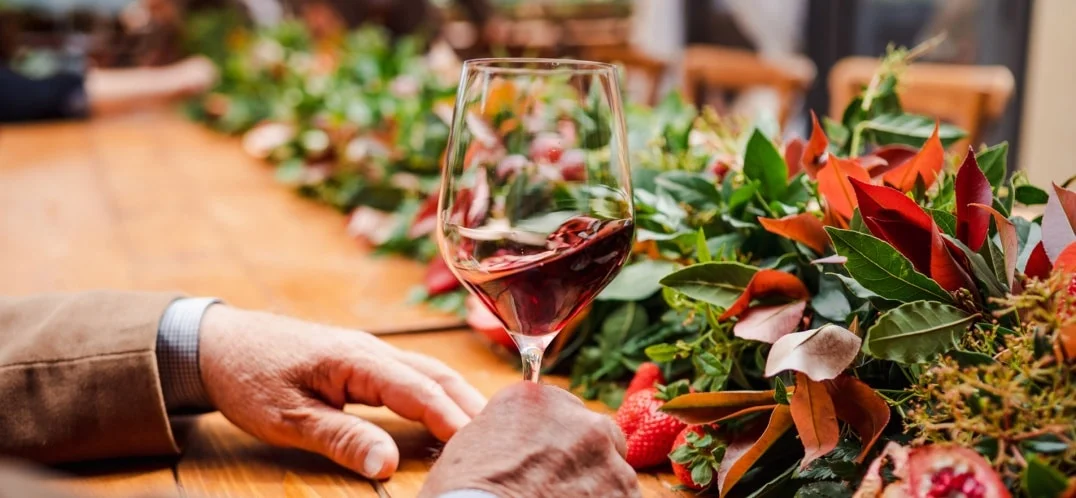
To taste a wine means to sample it for the purpose of judging its quality or defining its characteristics.
To taste a wine means to sample it for the purpose of judging its quality or defining its characteristics.
Doing it professionally requires studying and following certain rules on how to taste a wine, but anyone can do it, even the less experienced, by following a few simple precautions.
There are no differences between how to taste a red wine or how to taste a white wine – in both cases, it is a matter of performing a sensory analysis that involves sight, smell, and taste. And of course, relating what the senses perceive to your own experiences, memories, and personal emotions.
Among all the sensory systems, the visual one is certainly the most complex – consider that the optic nerve contains one million receptors compared to the acoustic nerve which contains only 30,000. Visual tasting begins by observing the wine as it is poured into the glass. You should hold the glass at eye level to assess its colour, transparency, and clarity. It is best to tilt the glass against a white background to bring out the colour tone. By rotating the glass so that the wine spreads across the sides of the glass, you will observe the “tears”: indicators of the wine’s viscosity and alcohol content. The smaller the tears and the more viscous the wine on the sides, the greater its structure and alcohol content.
Smell is never deceived, unlike other senses, such as sight. For this reason, in sensory analysis, the moment when you smell the wine is very important and requires particular concentration.
Olfactory stimuli reach the right hemisphere of our brain, which is responsible for creativity and emotions. Smell has direct connections with the hypothalamus, which governs our intimate and emotional life, and can modify brain activity, influencing our actions far more than we realise.
Wine is smelled from a still glass, breathing in deeply and quickly, then moving the glass away. Before smelling again, it is good to swirl the glass to release the volatile substances. The aromas perceived generally fall into six broad families: floral, fruity, vegetable, spicy, and other biochemical. You also try to perceive their intensity and complexity.
Now it’s time to taste the wine and understand how to taste it in your mouth, using your sense of taste. Like smell, taste not only shares similar receptors, with one operating on molecules dispersed in the air and the other on compounds dissolved or conveyed by a liquid medium, but also the fact that both reach the oldest areas of the cerebral cortex. The wine should be tasted in small quantities and held in the mouth to allow the taste buds on the tongue and palate to perceive its flavour (there are four flavours that the tongue can recognise: sweet, salty, acidic, and bitter) and its texture or body.
At the end of each tasting, it is customary to note the sensations experienced in a notebook so as to have a complete description. It is also useful for making comparisons with other bottles.

Wine guide

Food & Wine

Art & Culture

Wine guide

Food & Wine