





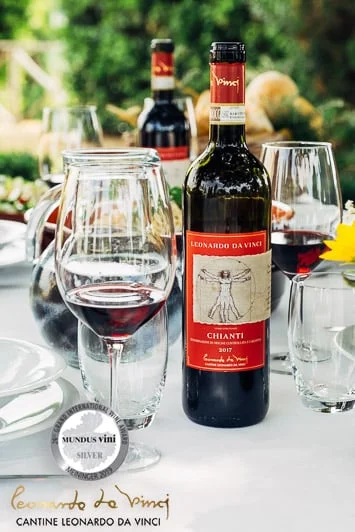
Polenta is a simple and ancient dish, typical of the North but widespread in every Italian region. The ingredients are fundamentally two: cornmeal and water. There is also a third, invisible but indispensable: time.
Polenta is a simple and ancient dish, typical of the North but widespread in every Italian region. The ingredients are fundamentally two: cornmeal and water. There is also a third, invisible but indispensable: time.
This is because to make polenta in the traditional way you need to put water on the fire to boil and then pour the flour “in a stream” gradually whilst continuing to stir constantly without stopping. Polenta is a typical winter dish, strengthening and comforting. But it is at the same time an economical, tasty and versatile dish because it lends itself to many interpretations.
Polenta is almost never enjoyed alone. It is always accompanied by a topping. It goes without saying that the pairing of polenta with wine depends on what type of interpretation you choose to bring this simple and timeless delicacy to the table.
[[LIST ul “
\u00a0
“]]
Among the most popular and beloved recipes is certainly that of “polenta concia”, that is enriched with the flavour of cheeses, especially alpine ones such as Fontina DOP or Bitto and malga butter. This is a very energetic dish, ideal for the end of a winter day spent in the snow. The right wine to pair with creamy polenta should therefore be a robust partner with medium body, such as for example San Zio Toscana IGT from the Villa da Vinci collection, obtained from the finest Sangiovese grapes grown in the vineyards of Villa Da Vinci.
A variant of traditional yellow polenta is “polenta taragna”, or simply taragna, in which, in addition to maize flour, buckwheat flour is also used. This is a real complete dish, typical of Valtellina that enthusiasts love to serve with cured meats or luganega.
The ideal wine to pair with polenta taragna, choosing from the wide range of Leonardo da Vinci offerings (which in addition to maize flour is composed of buckwheat flour, butter and cheese), is also a structured wine such as Sangiovese Riserva from the 1502 da Vinci in Romagna collection.
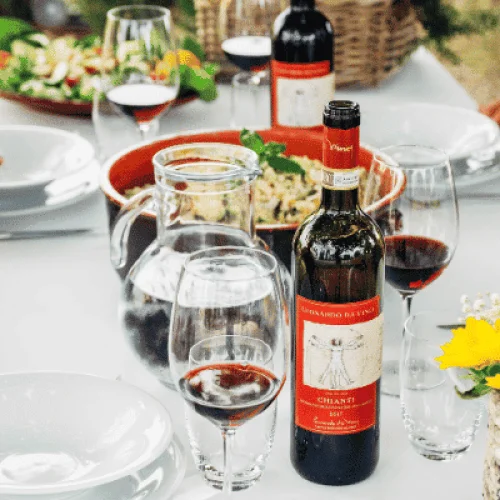
Polenta is a versatile dish, as we have said, since it manages to pair with any sauce: among the most loved are pairings with mushroom sauce, or meat sauce (from ragù to goulash, from sausage to stew). In these cases, the wine to pair with polenta with sauce is usually a red wine: a Rosso di Montalcino, for example, from the I Capolavori collection or a Toscana Rosso from the Leonardo da Vinci collection.
But polenta also pairs well with fish sauces or with delicate vegetables. So why not try a pairing with white or rosé wines? The Portocanale di Cesenatico is a Sangiovese Rubicone IGT rosé, and willingly accompanies a light dish of fish and polenta. Similarly, the Vermentino Streda is the ideal partner for a dish of polenta with a light fish sauce.
Being a dish of peasant origin, polenta has also been subject to reinterpretations in terms of domestic economy and “zero waste”: for this reason it is found in various sweet preparations. With the leftover polenta, in fact, you can cook cakes and biscuits. To pair, in this case, like a sweet and ancient wine such as Tuscan Vin Santo.
Polenta recipes are found in every Italian region, from polenta with cuttlefish eaten in Venice to “frascatula” (eaten in Basilicata and also in Calabria and Sicily and made with polenta, potatoes, sauce or cotechino), from fried polenta from Bari and Messina to sweet polenta prepared in Tuscany. The rule that always applies, in the case of pairings with micro-typical dishes of a locality, is to enjoy a local wine: because what grows together, goes together well.

Wine guide

Food & Wine

Art & Culture

Wine guide

Food & Wine